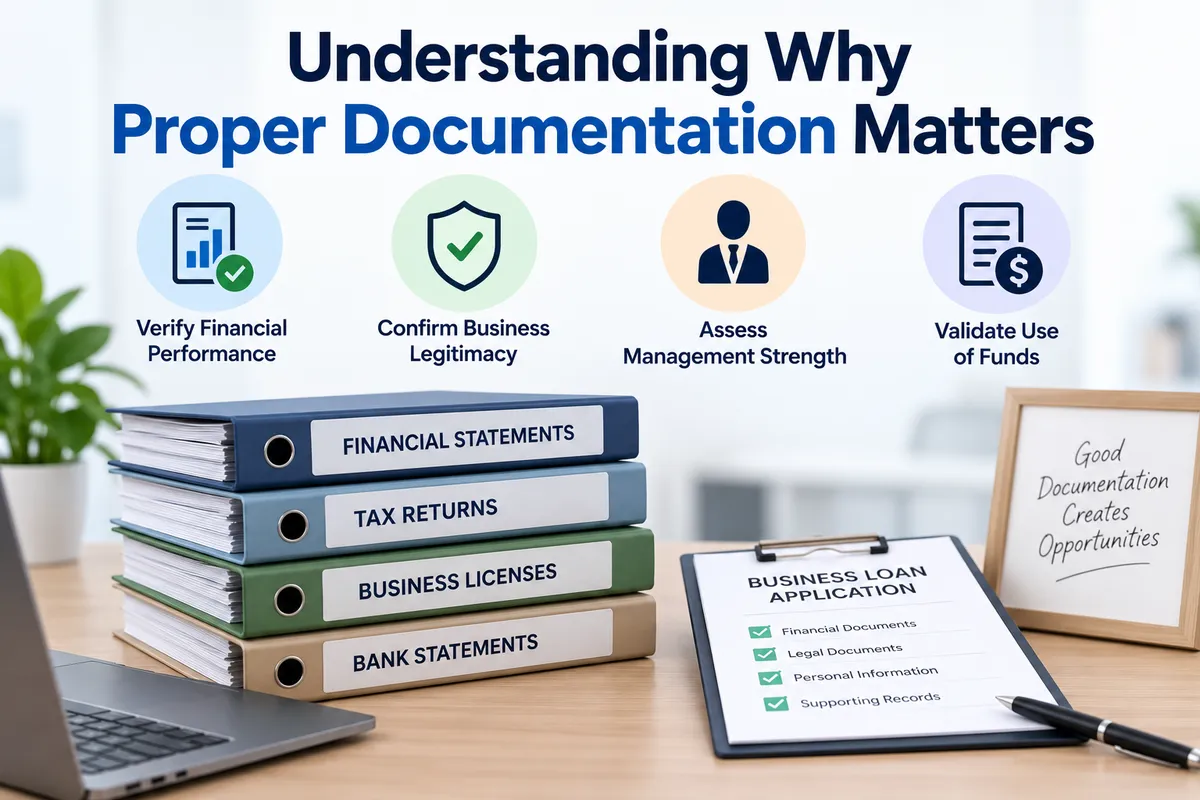
Understanding Why Proper Documentation Matters
Lenders make credit decisions based on what they can verify on paper. They use your documents to answer three core questions: Can you repay, will you repay, and what happens if you cannot.
When your documentation is complete and organized, you help the underwriter:
●Verify financial performance with consistent tax returns, financial statements, and bank records.
●Confirm business legitimacy through clear licenses, registrations, and formation documents.
●Assess management strength by reviewing your experience, track record, and planning.
●Validate use of funds so the loan request matches your cash flow and growth plans.
Gaps in documentation create uncertainty. Uncertainty slows down underwriting, triggers extra conditions, or can push your file to the side while cleaner applications move ahead.
Well prepared documentation is a readiness signal. It tells a lender that you manage details, respect timelines, and are likely to manage repayment the same way.
Essential Financial Documents
Lenders use your financial documents to test whether your business generates enough consistent cash flow to support new debt. Solid, current records reduce guesswork in underwriting and make it easier for a credit team to say yes to your request instead of asking for repeated clarifications.
Core financial documents to prepare
●Personal and business tax returns for the most recent [insert number] filing periods, signed and complete with all schedules. Lenders compare these to your internal financials.
●Business bank statements for the latest [insert number] months, all pages. Underwriters review deposits, withdrawals, and average balances to gauge real cash activity.
●Profit and loss (income) statements that are accurate through the most recent month or quarter, with clear revenue and expense categories.
●Balance sheets that list assets, liabilities, and owner equity as of the same date as your profit and loss statement.
●Cash flow projections for at least the next [insert period], showing how revenue, expenses, and debt payments will interact.
Accuracy and timing matter. Numbers across these documents should align, use consistent accounting methods, and be updated through the latest practical period. If something changed recently, be ready to explain and support it with documentation.
Business and Legal Documentation
Underwriters review your business and legal documents to confirm that your company is real, properly structured, and authorized to operate. Clean, current records reduce legal questions and let the credit team focus on capacity, not compliance issues that could slow or block a decision.
Core business formation and registration records
●Business licenses and registrations that match your legal name, trade name, location, and industry activities.
●Articles of incorporation or organization that show when and how the business was formed, and in which state.
●Operating agreement or ownership agreement that details owners, percentages, roles, and decision authority.
●Employer Identification Number (EIN) confirmation that ties your tax ID to the correct legal entity.
Operational and contractual documents
●Commercial lease agreements for any locations you occupy, signed and current through the requested loan term.
●Key contracts with customers, suppliers, or partners that support your revenue and cost structure.
●Franchise, license, or distributor agreements if your business operates within a larger system.
Keep these documents consistent with the information on your application. Name, ownership, address, and tax details should match across all records or be clearly explained in writing.
Personal Documentation and Credit Information
Lenders review your personal profile to understand who stands behind the business and how you have managed obligations over time. Even if the loan is for your company, your personal documentation often drives both structure and pricing.
Core personal documents to prepare
●Government issued identification such as a driver’s license or passport, clear and unexpired, for all guarantors.
●Personal credit reports for each owner or guarantor, reviewed in advance so you know what underwriters will see.
●Personal financial statement listing assets, liabilities, income, and expenses in a consistent format.
●Personal tax returns for the most recent [insert number] filing periods, especially if you report business income on Schedule C or through pass through entities.
●Resumes or bios where relevant, highlighting industry experience, management roles, and prior business history.
Why this information matters
Underwriters use these documents to assess your character, capacity, and global cash flow. They compare personal obligations to both business and personal income, watch for undisclosed debts, and look for consistent payment behavior. Clean, organized personal documentation signals that you are transparent, prepared, and ready for a serious credit review.
Preparing and Organizing Your Documentation
How you package your documents matters almost as much as which documents you provide. A lender reads your file as a story about how you manage risk, deadlines, and details. Clean, consistent organization helps underwriting move faster and reduces avoidable follow up requests.
Build a simple document system
●Create a checklist grouped by category: financial, business/legal, and personal. Use it to track what is complete, in progress, or missing.
●Use clear folders labeled by section and year, for example: “Financials [insert period]” or “Legal and Entity Docs”.
●Keep digital and hard copies. Store PDFs in a secure folder and keep a parallel paper file for meetings or quick reference.
Make everything easy to review
●Label every file with document type, business name, and period, for example: “ABC LLC Profit and Loss [insert period]”.
●Use legible scans, all pages, right side up, with signatures and dates visible.
●Add a cover sheet that lists included documents and any short notes that clarify name changes, ownership shifts, or recent events.
The goal is simple. A loan officer should be able to find any document in seconds and understand your file without guessing or chasing you for missing pieces.